
AI Insights into the Modular Laundry Performance Shift
Despite its strong distribution footprint and enduring brand equity, the company was navigating increasing pressure in a mature, globally scaled laundry care market defined by intense competition and shifting consumer expectations.
Global Company Size: multi-billion-dollar annual revenue
Company Type: Publicly traded U.S. consumer packaged goods (CPG) company
Portfolio : Household, Fabric Care, Health & Personal Care brands
Category Focus: Laundry Detergent & Fabric Additives
Team: Brand Strategy & Consumer Insights
CHALLENGE :
Despite its strong distribution footprint and enduring brand equity, the company was navigating increasing pressure in a mature, globally scaled laundry care market defined by intense competition and shifting consumer expectations. The competitive landscape had matured to the point where core performance claims stain removal, odor control, freshness were widely expected rather than differentiating.Consumer conversations revealed a redefinition of performance, where sensory endurance, economic efficiency, and routine reliability increasingly shaped decision-making.Retail environments were accelerating experimentation and influencing how consumers constructed multi-step laundry routines.
The insights team needed to understand what was driving these shifts: why some consumers prioritized scent intensity while others anchored on reliability and longevity, how retail context accelerated brand switching, and where perceptions of value were overtaking perceptions of performance.Traditional brand trackers and POS data could quantify sales and repeat purchase, but they could not explain the behavioral and emotional drivers behind these changes leaving the organization without a unified view of how “performance” was being redefined in the category.
SOLUTION
To understand how “performance” was being redefined in laundry care, the company deployed the CREWASIS Decision Intelligence Platform to analyze large-scale, unstructured consumer conversations across social, retail, and video environments.
Rather than relying solely on brand trackers and POS metrics, the platform surfaced how consumers themselves define effectiveness, value, and trust in real-world language across retailers, deal moments, and routine behaviors.The CREWASIS Decision Intelligence Platform applied large-scale behavioral clustering, sentiment modeling, and cross-channel narrative analysis to map how consumers define effectiveness, value, and freshness in real-world language.
Performance Is Proven Through Everyday Proof
The CREWASIS Decision Intelligence Platform revealed a structural shift in how consumers define performance. Marketing claims alone no longer drive credibility. Effectiveness is validated through lived experience, visible cleanliness, odor elimination, scent endurance, and repeat reliability across real-world use.
Fragrance longevity emerged as a powerful signal of functional success, while economic efficiency is increasingly evaluated through cost-per-use logic rather than shelf price alone. Performance has moved from being claim-based to experience-based, reshaping how trust is earned within the category.
Value Is Engineered, Not Assumed
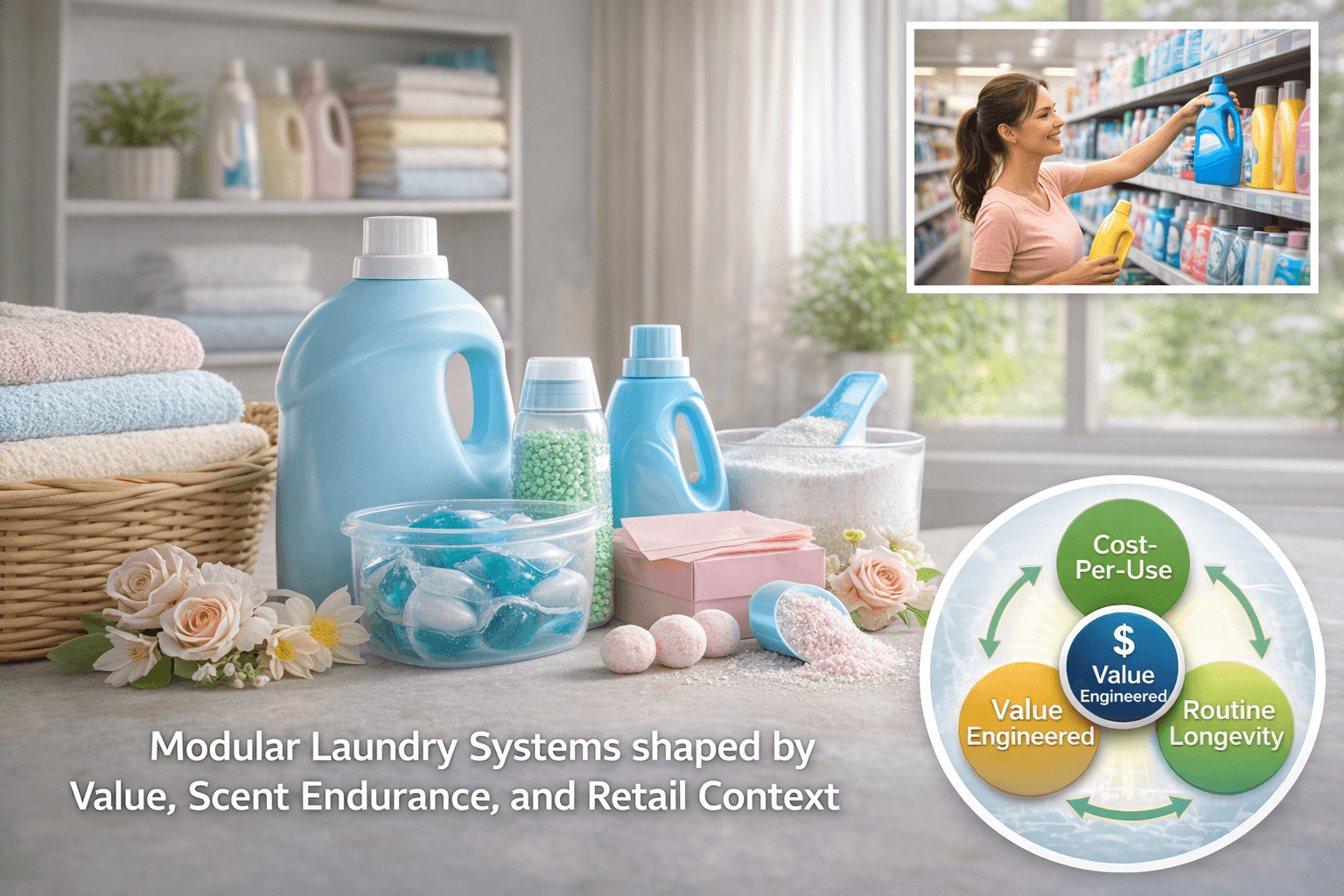
The platform uncovered a dominant behavioral shift: consumers increasingly evaluate value at the system level rather than at the individual SKU level. Economic effectiveness is calculated through cost-per-use, refill frequency, and total routine efficiency rather than sticker price alone.
Value is no longer assumed through brand equity. It is actively constructed through planning, comparison, and perceived longevity. Consumers seek confidence that their routine delivers both sensory payoff and economic optimization, reinforcing identity as informed, deliberate shoppers.
Layered Laundry Systems Redefine Routine Behavior
Analysis revealed a transition from single-product reliance to modular routine construction. Consumers increasingly combine detergents, rinse products, boosters, and finishing elements to engineer customized outcomes across cleaning strength, odor control, and fragrance endurance.
Fragrance longevity functions as a visible reinforcement of effectiveness, strengthening attachment to specific routine architectures. At the same time, traditional category roles are evolving. Fabric softener is increasingly treated as discretionary, while rinse and sanitizer products gain relevance in odor-intensive scenarios. Laundry behavior has shifted from linear product use to intentional system design.
Retail Context Shapes Loyalty Pathways
The CREWASIS Decision Intelligence Platform identified distinct behavioral differences across retail environments. Price-oriented channels tend to accelerate experimentation and stock-up behavior, while assortment-driven environments support full-system replenishment and coordinated product discovery.
Brand switching is often influenced by purchase context and perceived value alignment rather than dissatisfaction with core performance. Retail environments therefore shape not just where products are purchased, but how routines are assembled and maintained over time.
Results:
System Architecture Outperforms Single-SKU Positioning
Analysis revealed that consumers increasingly construct coordinated routines rather than relying on a single detergent to deliver outcomes. Cleaning strength, odor removal, fragrance longevity, and personalization are achieved through layered product combinations. Growth opportunities therefore lie in ecosystem alignment and portfolio integration rather than isolated SKU optimization.
Economic Transparency Strengthens Trust
Effectiveness is evaluated through visible economic logic cost-per-use efficiency, refill frequency, and perceived longevity. Clear value communication enhances credibility more than brand equity alone. Trust is built when consumers feel both sensory and economic confidence in their routine.
Fragrance Has Become a Primary Loyalty Driver
Scent strength, projection, and endurance function as experiential proof of performance. When fragrance delivers sustained and noticeable impact, attachment and repeat behavior increase. Fragrance has evolved from a secondary attribute to a central reinforcement mechanism within modern laundry systems.
Retail Context Influences Routine Construction
Retail environments shape how consumers assemble and maintain their routines. Price-oriented channels tend to accelerate experimentation and stock-up behavior, while assortment-driven environments enable full-system coordination. Distribution context influences routine architecture as much as brand messaging.
About
This project analyzed how modern laundry routines are evolving across diverse retail and digital environments, using AI-driven behavioral clustering, text modeling, and sentiment analysis to uncover structural shifts in consumer decision-making.
The objective extended beyond measuring brand preference. It focused on understanding how consumers now define performance, value, freshness, and routine architecture within an increasingly price-conscious and fragrance-driven category.
By synthesizing large-scale unstructured conversations into a unified behavioral framework, the initiative revealed a fundamental shift: laundry is no longer a single-product decision. It is a modular system shaped by economic logic, scent identity, and purchase context. The output became a behavioral blueprint for how consumers engineer cleaning strength, fragrance endurance, and efficiency simultaneously.
Before AI-Driven Insights
Prior to AI-enabled modeling, understanding laundry behavior relied heavily on retail sales reporting, static surveys, and product-level performance metrics.
What remained unclear was:
Why consumers were increasingly constructing multi-step routines
Why cost-per-use calculations outweighed sticker price in perceived value
Why fragrance endurance had become a signal of effectiveness
Why certain traditional categories were becoming discretionary
How retail context influenced routine assembly
Traditional KPIs measured brand share and promotional lift, but they did not capture the structural evolution occurring within consumer rituals. Cross-category behavioral patterns remained fragmented across platforms and datasets.
AI enabled the integration of these signals into a unified system-level view.
Choosing AI to Decode Routine Engineering
The AI system structured insights across five core behavioral dimensions.Economic modeling revealed that consumers evaluate value at the cost-per-use level rather than through sticker price alone, reinforcing the importance of perceived longevity and efficiency.Layered fragrance systems demonstrated that optimal sensory outcomes are engineered through coordinated product use, with scent endurance acting as experiential reinforcement.Retail context analysis showed that purchase environments influence how routines are constructed, whether through experimentation or full-system replenishment.
Performance modeling confirmed that odor elimination often precedes fragrance layering, reinforcing the rise of dual-step cleaning architectures.Category signals also indicated that fabric softener is increasingly discretionary, while rinse and booster products gain functional authority within evolving routines.Together, these findings shifted focus from individual product claims to interconnected behavioral systems, enabling patterns that previously required months of manual synthesis to be structured in days.
Today: Engineered Value, Engineered Freshness
The brand now applies continuous AI-driven behavioral modeling across retail and digital ecosystems to track shifts in scent layering, booster momentum, cost-per-use sensitivity, rinse adoption in odor-intensive scenarios, and evolving softener relevance.These insights inform portfolio architecture, pricing strategy, innovation planning, and positioning priorities. Messaging aligns with value-conscious behavior by emphasizing economic transparency and defining product roles detergent as the cleaning foundation and rinse as targeted odor reinforcement.
Performance is no longer measured solely by unit sales, but by how effectively the portfolio integrates into the consumer’s engineered routine.Laundry has evolved from a single-SKU purchase to a modular, value-optimized system and AI made that structural shift visible.
Synopsis:
Consumers were no longer buying a single detergent; they were building modular laundry systems shaped by value, scent endurance, and retail context.
Portfolio Strategy Reframedthrough CREWASIS Decision Intelligence